Curriculum
Business and Technology
A. The Business Organization and its External Environment
0/11
-
A1. The Purpose and Types of Business Organization

-
ACCA-BT-A1

-
A2. Stakeholders in Business Organizations
Preview
-
ACCA-BT-A2
-
A3. Political and Legal Factors Affecting Business
-
A4. Macroeconomic Factors
-
A5. Microeconomic Factors
-
A6. Social and Demographic Factors
-
A7. Technological Factors
-
A8. Environmental and Sustainability Factors
-
A9. Competitive Factors
B. Organizational Structure, Culture, Governance, and Sustainability
0/5
C. Business Functions, Regulations, and Technology
0/7
D. Leadership and Management
0/6
E. Personal Effectiveness and Communication in Business
0/5
F. Professional Ethics
0/4
A2. Stakeholders in Business Organizations
📘 2.1. Key Business Stakeholders
A stakeholder is any person or group with a vested interest in the success and activities of a business. They are affected by the company’s actions and can, in turn, influence its performance. Stakeholders are divided into two main categories: internal and external.
Internal Stakeholders
These are the individuals or groups who are directly connected to the business. Their interests are often tied to the company’s success, as they are part of its daily operations.
Employees
They are crucial for productivity and quality. Their objective is to have good wages, job security, and career opportunities.
Managers
They are responsible for business strategy and operations. Their goal is to achieve company objectives, increase profitability, and advance their own careers.
Owners / Shareholders
They provide capital and have a vested interest in the business’s financial success. Their main objective is to maximize their return on investment (ROI).
Connected Stakeholders
These stakeholders have a direct economic or contractual relationship with the business.
Customers
They are the source of revenue. Their objective is to get high-quality products or services at a fair price.
Suppliers
They provide the materials and services a business needs. Their goal is to have a profitable, long-term business relationship and be paid on time.
Creditors/Lenders
They provide loans and credit. They are concerned with the company’s financial stability to ensure their debts and interest are repaid.
Distributors/Retailers
They connect the business to the final customer. Their objective is to have effective pricing and a reliable supply chain.
External Stakeholders
These are groups or individuals outside the business who are still affected by or have an interest in its actions.
Government
It sets legal and regulatory frameworks. Its objective is to ensure the business operates legally and contributes to the economy through taxes and job creation.
Local Community
It is impacted by a business’s operations, positively or negatively. The community’s objective is for the business to create local jobs and be environmentally and socially responsible.
Media
It shapes public perception. Positive or negative media coverage can significantly impact a company’s reputation and brand.
Pressure Groups
They aim to influence a business’s behavior to align with their specific causes, which can lead to protests or boycotts.
Trade Unions
They represent workers’ interests in negotiations over wages and working conditions.
🏢 2.2. The Agency Relationship
- The agency relationship exists when one party, the principal, delegates authority to an agent to act on their behalf.
- The core issue is the principal-agent problem, which arises from potential conflicts of interest and information asymmetry.
- For example, shareholders (principals) want to maximize profit, while managers (agents) might prioritize personal gain.
How the Agency Relationship Varies
Sole Proprietorship
There is no agency problem. The owner is both the principal and the agent, so their interests are fully aligned.
Partnership
Each partner is both a principal and an agent. While they share the goal of success, conflicts can arise due to different individual priorities.
Corporation
This is the classic example of the agency problem. There’s a significant separation of ownership (dispersed shareholders) and control (managers). This creates high potential for conflicts, as managers may pursue their own interests at the expense of shareholders.
Cooperatives and Non-Profits
The agency relationship is different because profit maximization isn’t the primary goal. In a cooperative, members are the principals and management are the agents, with the goal of serving member interests.
In a non-profit
beneficiaries and donors are the principals, and the conflict is about ensuring resources are used effectively and ethically to achieve the organization’s mission.
For larger companies, this has led to the separation of ownership of the company from its management. Thus, there is potential for conflicts of interest between management and shareholders, i.e., the agency problem.
📑 2.3. Stakeholder´s Groups Interaction and their Conflict
Stakeholder groups within an organization are interconnected, and their interests often conflict, posing a constant challenge for management. The interactions are dynamic, with information and resources flowing between internal, connected, and external groups.
How Stakeholder Groups Interact
- Internal with Internal:Managers interact daily with employees, and owners/shareholders monitor managers’ performance and compensation.
- Internal with Connected: Employees and managers work directly with customers. The company’s purchasing and finance departments interact with suppliers and creditors.
- Internal with External: Managers ensure compliance with government regulations. Public relations teams engage with the media and local community.
- Connected with External: Customers are influenced by media reports and pressure groups. Suppliers must comply with government regulations, which can affect their pricing.
How Stakeholder Objectives May Conflict
The fundamental challenge for any business is balancing competing demands. A decision that benefits one group may be detrimental to another.
Shareholders vs. Employees
Shareholders want to maximize profits, which might mean cutting costs like employee wages or benefits. Employees want higher wages, better benefits, and job security, which could reduce short-term profits.
Shareholders vs. Customers
Shareholders want to maximize profits, which can be done by raising prices or using cheaper materials. Customers, however, want the highest quality product at the lowest price.
Management vs. Employees
Managers want to increase productivity and efficiency, which could lead to longer hours or job losses through automation. Employees want a good work-life balance and job security.
Business vs. Local Community
A business wants to expand for profit, which might lead to pollution and traffic. The local community wants a clean, safe environment, even if it means opposing business expansion.
Shareholders vs. Government/Society
Shareholders want short-term returns. Society and the government want the company to be socially and environmentally responsible, even if it requires costly investments that reduce profits.
Effectively managing these conflicts is essential for a business’s success and reputation. Failure to do so can lead to a damaged brand and loss of confidence from both investors and customers
2.4. Power and Interest of Various Stakeholder Groups
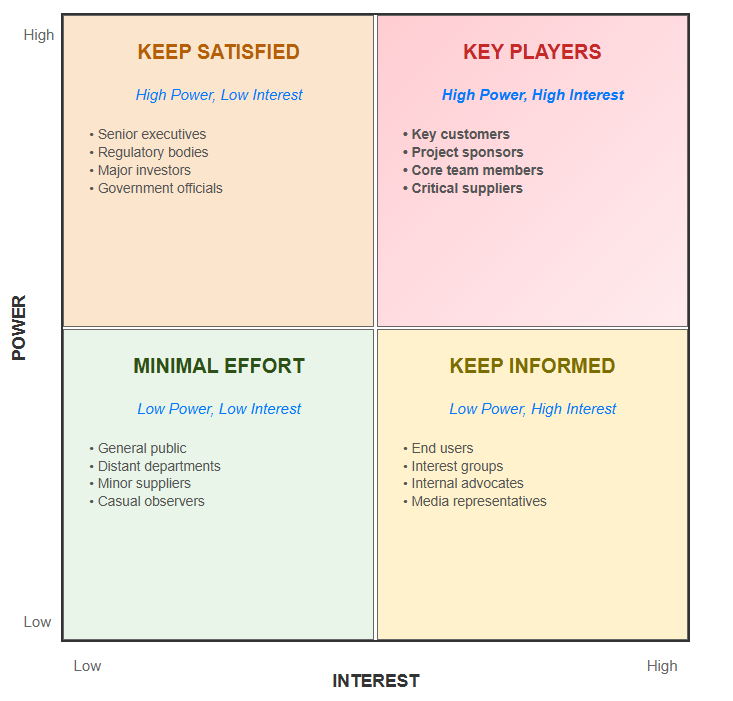
Mendelow (1991) classifies stakeholders on a matrix whose axes are power held and likelihood of showing interest in the organization’s activities.
Power
Power is the ability of individuals or groups to persuade, induce or coerce others into following certain courses of action. Power emerges from:
- Within Organization – Hierarchy, influence, control, possession of knowledge
- External Stakeholders – control of strategic resources like raw materials, specific knowledge
Interest
Interest is the attention that they pay to the organization and a particular issue within it, which is assessed by 3 factors:
- Criticality: degree of effects on stakeholders
- Channels: pay attention when there are good channels of information and communication.
- Cognitive capacity: the ability to attend and analyze the flood of information
How to Account for Their Needs
The matrix is a strategic framework for action. It helps organizations prioritize resources, tailor communication to each group, and anticipate and mitigate risk by identifying high-power stakeholders early on. It also helps leverage opportunities by finding highly interested groups that can provide valuable support.
- Issues with Mendelow’s Matrix
- Very difficult to measure each stakeholder’s power and interest
- The map is not static. Stakeholders may be moving from one category to another.
- Based on the idea of strategic repositioning, rather than moral or ethical concerns.
- Because of conflicting views of stakeholders, there may be uncertainties over the organization’s future direction.
- Fails to take legitimacy into account.